Listening for the Alien Heartbeat

I am not a man given greatly to prayer.  In a tight situation where others pray for help and guidance, I curse.  Serious, thorough, air-shaking curses.  The kind of cursing that may save your life but will condemn you to hell. [1]

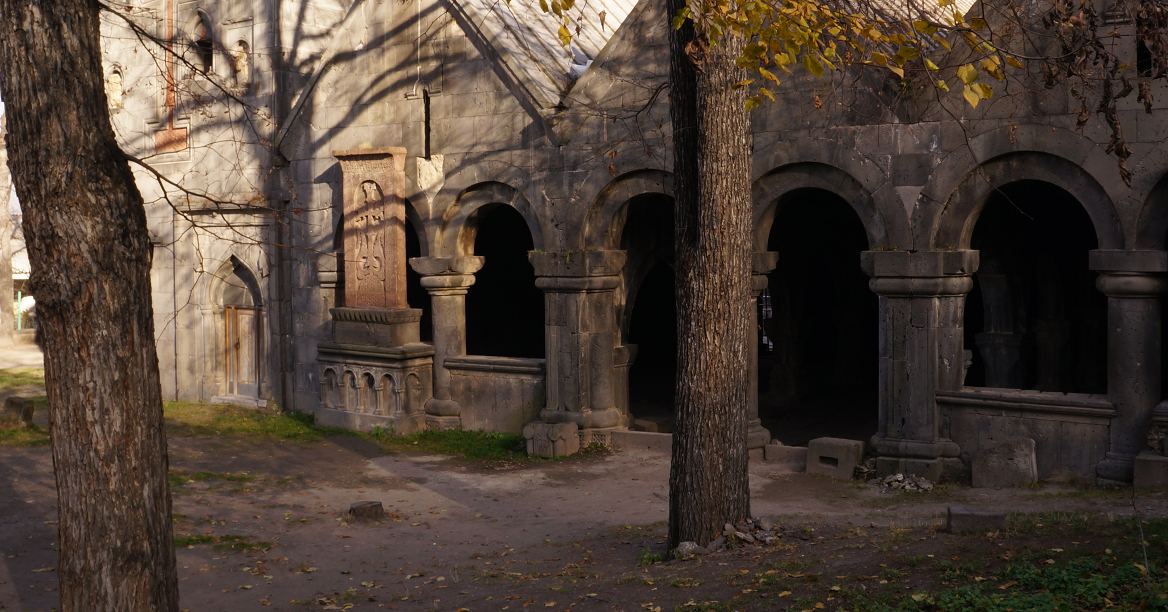
But entering an Armenian church, even I go quiet and lower my eyes.  In an Armenian church, you are accompanied by saints:

Watched By Saints

Walking in, you cross the bones of saints.  As you kneel, they watch over you:

Akhtala - main - ancient_place_to_pray

Inside you normally buy a few candles, put them in a flat bed of sand covered in water, and light them.  The light that shines, shines for everyone:

Akhtala - Candles - In_the_Presence_of_the_Light

I asked an Armenian friend Marianna why they have so many saints.

“Because we are a very good people”

As you leave, they remind you they walk with you:
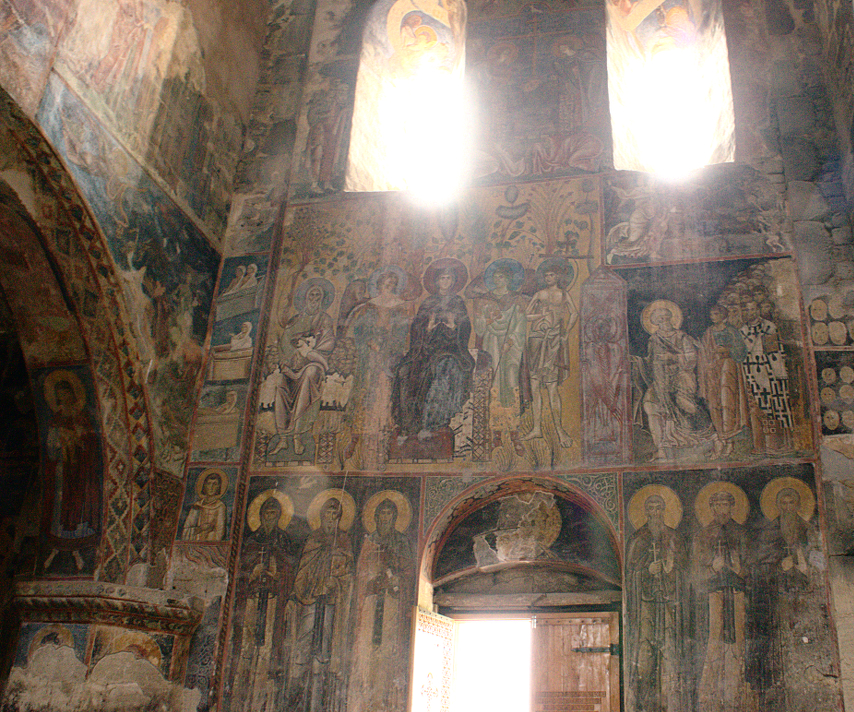
Akhtala - exit - walking with holiness


[1]    Once, caught alone in a sandstorm in the Baluchi desert (on a motorbike), and thoroughly irritated (with myself) that I might not survive this latest stupidity, I broke out into such a loud and thorough cursing that I managed to keep moving through the turbulence, until the blowing sand ahead parted long enough for me to see the orange-red ball of the setting sun, and establish due west.

West was where I was headed, and getting my bearings calmed me down.  In fact I had briefly forgotten I had a compass, and could have used that to get my bearings.  But, as those who have been there know, faced with death, one forgets one’s compass.


10 Comments

Where would we live if we suddenly became de-industrialized, as Armenia became de-industrialized after the fall of the Soviet Union?  If our factories deserted us?  If much of our infrastructure fell into disuse?

Disused, sunk carriage

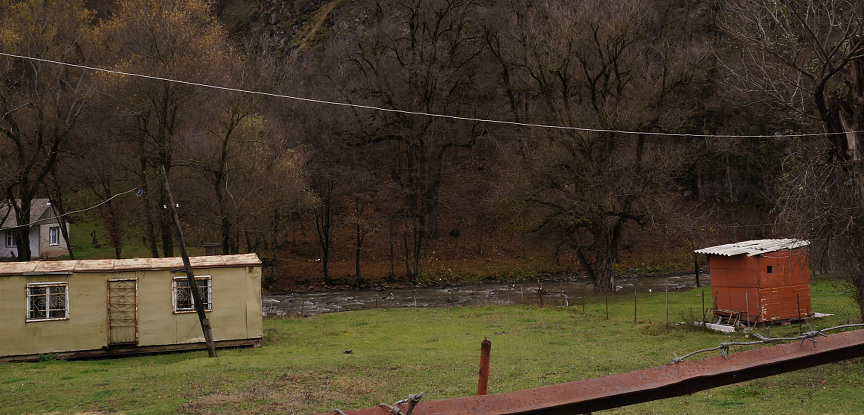
We would convert whatever we had.  Live in the shells left behind.  In old railway carriages:

Armenia - Debed Valley - Green Carriage used as House

In containers once used for exporting our products:

Armenia - Yellow Container House

and metal boxes once used for road-freight, now not needed.  We would paint them and hang curtains:

Armenia - Container houses

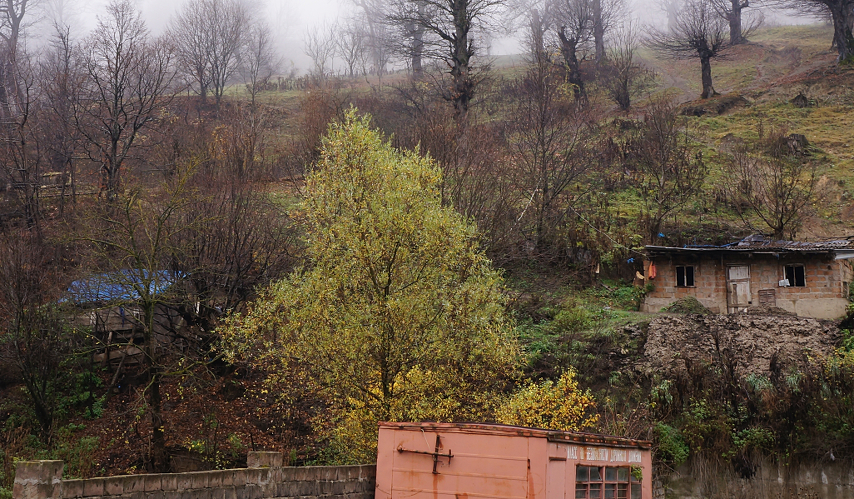
Of course many live much better than this.  But those who claimed and converted these artifacts of a lost industrial era also live better than many:

Hill with house and pink metal building


5 Comments

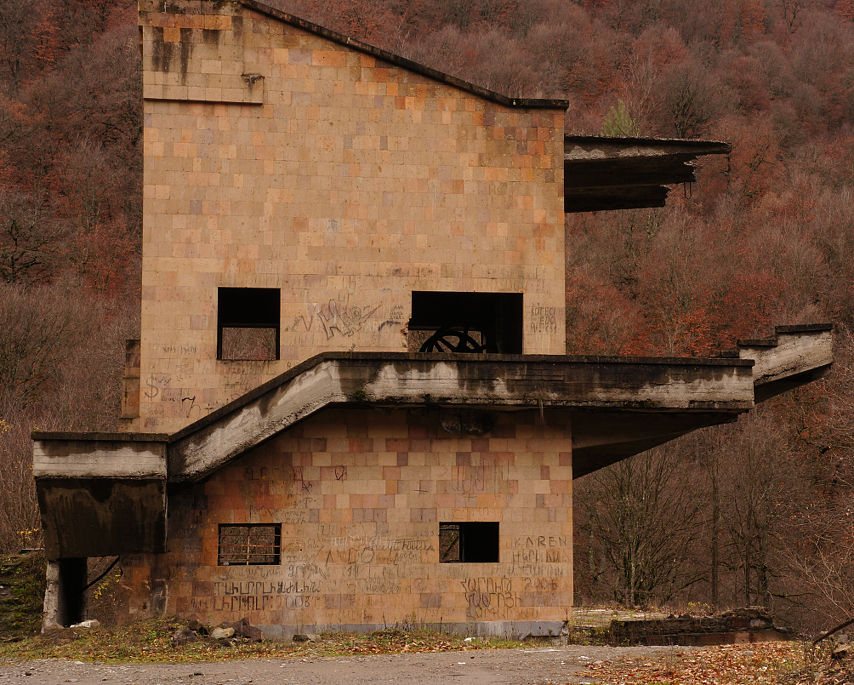
Factories closed all over Armenia.  Abandoned, overgrown factories:

Armenia - Deserted Factories

As far as the eye can see:

Armenia - Deserted Factories Along Debed Valley Rd

After Chernobyl Armenia closed its own nuclear power plant.  Then came the collapse of the Soviet Union, the debilitating war with Azerbaijan, the blockade by Turkey.  There was no money and no power – and factories closed all over Armenia.  Even the capital Yerevan went dark – for four years people were forced to forage in the mountainside for wood for heating and cooking.

Even now, 18 years later, the rusting infrastructure:

Armenia - Deserted Wheelhouse

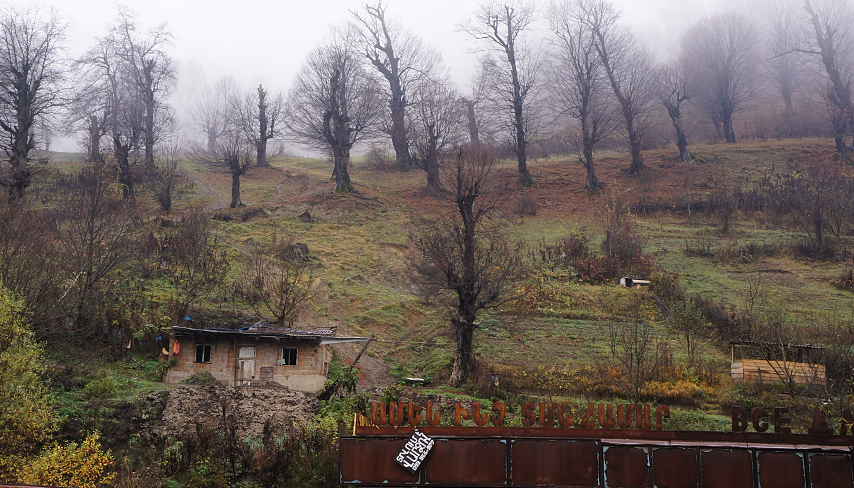
and bare hills remain.  A post Soviet industrial landscape:

Armenia - Rolling Hills - Soviet Debris

Mostly these factories have not re-opened, people just live among them.  The white sign says ‘to rent’:

Armenia - Hill with house and old metal building

So why has Armenia not recovered?   A corrupt oligarchy runs the country for itself – Armenia is ranked 105th out of 176 countries on Transparency International’s corruption index, in the distinguished company of Gambia, Kosovo and Mali.

So World Bank money gets misused, the average wage is $300 and 36% of the population lives below the poverty line – in 2009 $85 / year.  Yes, that is 23c / day.

This type of government beggars not only the present generation, but the next:  youth unemployment is 57% – no.1 in the world – higher even than the miserable West Bank –  despite 99.6% literacy.

So abandoned by their factories, and abandoned by their government, Armenians work their land:

Armenia - boy with sheep

but face a road that this hard-working, well-educated, decent people don’t deserve:

Armenia - abandoned car on lonely road


8 Comments

There was apricot jam from their apricot tree, pears, apples, plums and walnuts from their garden, and a large grandmother in black, rolling cabbage rolls.

A picture of their son in uniform was on the mantelpiece, a cross leaning against it.  I did not need to ask – many Armenian mantelpieces have a crucifix leaning against a picture of a 20-something boy in uniform.  It was their son, killed like so many other sons, in the 1988-94 war with Azerbaijan.

These people were my hosts. Around the place were an accordion, a violin (which the husband used to teach), dusty Beatles records, a 1950s gramophone, books in Russian, English and Armenian, carpets on the wall.

There was always food out somewhere and food being cooked.  That night at dinner:

“We have homemade vodka *and* homemade wine.”
“Ah, sorry, I don’t drink.”

My host did not think this was worth discussing:

“You are in wrong country.  You will drink”

Hospitable people.  Civilized people.  All the greater pity that they live in a depressing, deforested, industrial wasteland.  Left by the Soviets as they retreated from history:

Alaverdi - chimney

Not just me who got depressed.  An Armenian friend Aleksandr, posted here once, described it:

“Alaverdi…even food changes taste…suicide trigger”

Alaverdi - industry - copper mine

Yet living here, this boy tending his pigs:

Sarahart - boy_tending_pigs

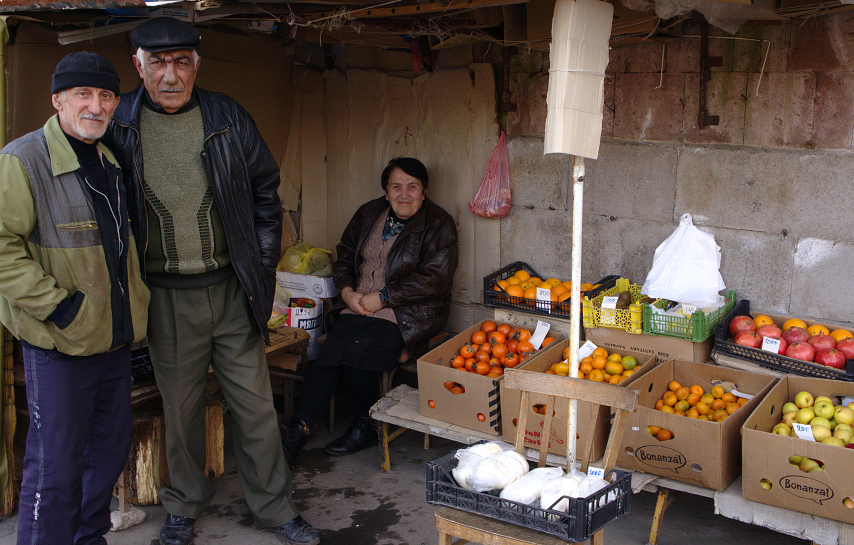
One afternoon after walking on the plateau just above Alaverdi, I was hungry so hung around the Sarahart town square eating peanuts, bananas and dried apricots.  I bought and ate apples and oranges from these people:

Sanahin - fruit_vendors

though the gent on the left was unable to persuade me to buy any of his meat:

Sanahin - meat_chopper

And this dual headstone, following the custom of husband and wife to be buried together:

Sanahin_church - dual_headstone

Even in death nice people, serious people, people worthy of respect:

Sanahin_church - dual_headstone - closeup

People who somehow have kept their souls despite the destructions of centuries and the desolations of today.  I finally start to understand.  Armenians.
.


13 Comments

From the light alone you know you are in a holy place:

Haghpat church - Light of GodThis is a place where you stand under heaven in the hall of the ancient God:

Haghpat Church - ancient graceThese floor stones, carved with names, cover the graves of saints:

Haghpat Church - entrance stones - graves of saintsCold but illuminated.  An inscription reminds us:

“You who enter through its door and prostrate yourself before the Cross, in your prayers remember us…who rest at the door …”

Haghpat church - interior grave stones - MadonnaThe Haghpat Monastery, built by the devout in 976, burnt by Mongols, burnt by Turks and burnt by Persians, seems to re-grow out of the ground.  Beautiful even on a gray winter day:

Haghpat - church growing from groundSupposedly built by the estranged son of the master who built the almost equally beautiful Sanahin Monastery.  When the father walks across the valley and finally comes to see it, he says to the son he now understands:  the walls are solid, they will stand.  From this comes the name “Haghpat”.

Haghpat Church - side wallAs I stood on the edge of the valley, preparing to walk across back to Sanahin, I felt the soft breath of the middle ages on my neck:

Haghpat - wall - mountains(events  3/Dec/2012)

.


29 Comments

I ascended in an old, rusty, somewhat cracked, soviet-era cable car, from Alaverdi, an ugly mining town at the bottom of the valley, almost vertically to Sarahart, at the top of the plateau.  A kilometre down was the dust and industry I might soon be forced to disturb.  Some idiot guide-book had suggested this was a “fun way to ride” to Sarahart.  While there are a few guide-book writers I would take to lunch, the vast majority should be vaporized as soon as appropriate hardware becomes available.

Exiting at the top, there were cows, chickens and some rundown gardens.  The cows waiting, as usual, for events to take a turn in their favor, and the chickens, as usual, going about their business with their usual recklessness.

Walking a bit further uphill, the town square was dominated by fruit sellers selling fruit from cardboard boxes and a man with an ax and a carcass selling meat by the chunk:

Sarahart Square - Fruit Sellers, Meat Sellers

A poor town, tumbling but nice houses:

Sanahin - Green? Blue? House

people making a living from their produce and livestock:

Sanahin - Boy Tending Family Pigs

Yesterday, not far from here, I had seen a man grazing his 12 cattle, and today scattered boys each grazing a few pigs.  Men stood around idly, hitching their pants.  An economist would sum it up, as he would sum up poor places everywhere:  low productivity of labor.

A place whose only frill had long deserted it:

Sanahin - There Once Was a Cafe

except perhaps for the long-distance bus whose passengers push-started it at the beginning of their journeys, before relaxing inside their curtained windows:

Sarahart - Long Distance Bus With Curtains

Another 30 minutes and I reached my objective:  the 10th century Sanahin Monastery.  The first building was built in 928, the library in 1062 and the medical school in 1100.  Once an empire, now a village.

Sanahin Monastery - Once Wealthier

The buildings were squat, like a fortress, but harmonious, and now with moss on the roofs and creepers coming down the walls.  The insides held the scattered dust of learning in a quiet, cool peace.

Sanahin Monastery - Dust of Learning

A path led up to a cemetery.  The stones on the right are actually gravestones:

Sanahin Monastery - Path Leading to Cemetery

From this cemetery souls can roam, like me, the surrounding mountains, valleys and ancient holy places:

Sanahin - Cemetery Overlooking the Valley

As I walked around the area, on every near hilltop I could see ruins.  But the roads now were lined with fruit trees.  A man driving smelly, unshorn sheep.  And the sound of a braying donkey.

(events 2/Dec/2012)


7 Comments

The church at Odzun, built in the 6th century, still stands:

Odzun 6th Century Church

and is still used.  An ancient Madonna from an ancient church:

Odzun Ancient Church - Ancient Madonna

Child born 1840, died 1840The cemetery outside has a testament to Armenia’s ancient power:
a gift from an Indian king in the 8th century,
and modern subjugation:
the graves of those who were born and died while Armenia was still under the Ottoman empire
just before the modern age was born.

Many of the graves speak of tougher times, of children who died in the same year they were born.

The village of Odzun now seems a typical Armenian farming community, hay and dung piled high, men still moving firewood by donkey, and metal baths outside houses:

House with Bath outside

though I never worked out whether these were actually for bathing.  Nearby the Horomayri Monastery, a ruin on the edge of the plateau, facing mountains:

Odzun-Ancient Monastery at Edge of Cliff

Edge of a plateau really means at the edge:

Monastery at Edge of Cliff

But I left depressed that such an ancient, mountain-facing house of prayer could be so surrounded by rubbish:

Ancient Monastery in Rubbish Dump

(events 01 Dec 2012)


5 Comments