Listening for the Alien Heartbeat

I am walking up to the ruins of Kobayr Convent, the mountaintop retreat of a set of unusually muscular 13th Century nuns.

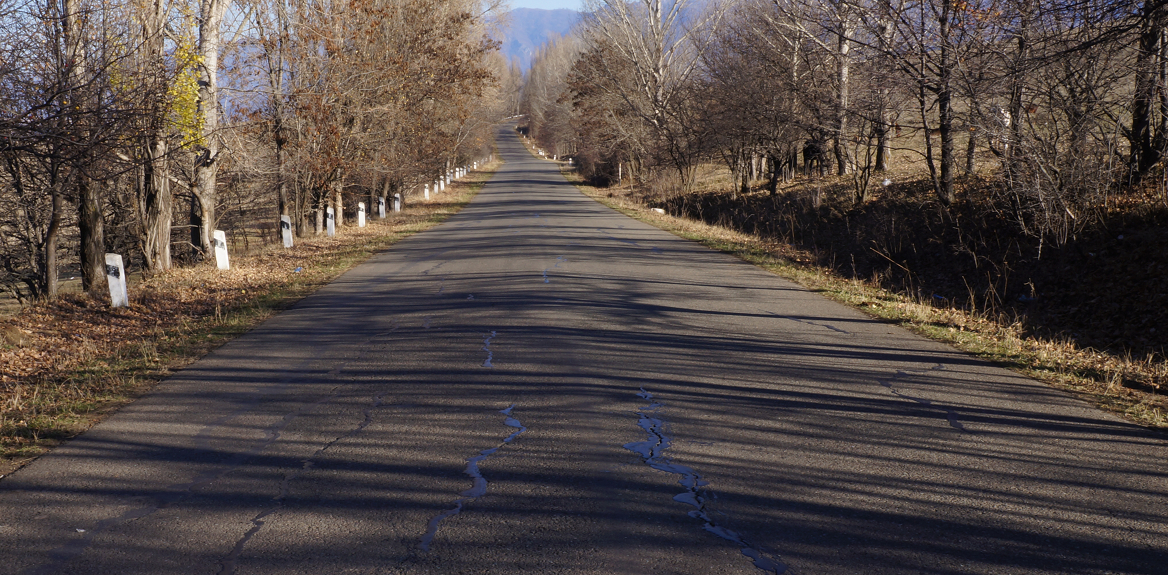
I leave the main road that follows the Debed river, cross the railway line and head upward.  The single railway line is more important than it looks:  it links Armenia to Georgia in the north, while east, west and south are blocked by hostile neighbors Turkey and Azerbaijan.

Kobayr- Road Runs Along Railway

Trains come through only 4-5 times a day, so even with my history of poor judgment and bad timing, my chances of getting knocked over by one are remote.

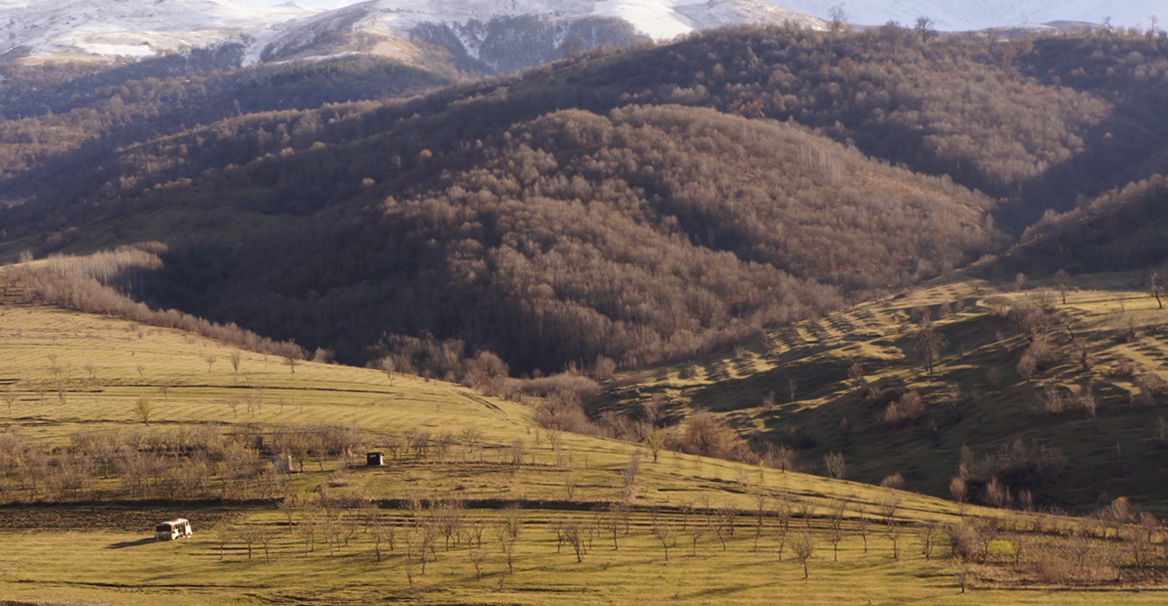
At the lower levels of the mountain a farming community makes its living.  It does not seem like much of a living as the houses are in generally poor repair.

Kobayr- Village Houses in Poor Repair

though still working.  The track up leads between houses and barns and past some very friendly looking roofs:

Kobayr - Friendly Rooves of Village Houses

About 1/2 way up I realize I am lost.  I shout to a local farmer “turn left or right”.  Rather than answer he grabs his big stick, works his way up to me and then kindly leads me up.  He has probably determined the further away he gets me the less damage I can do.

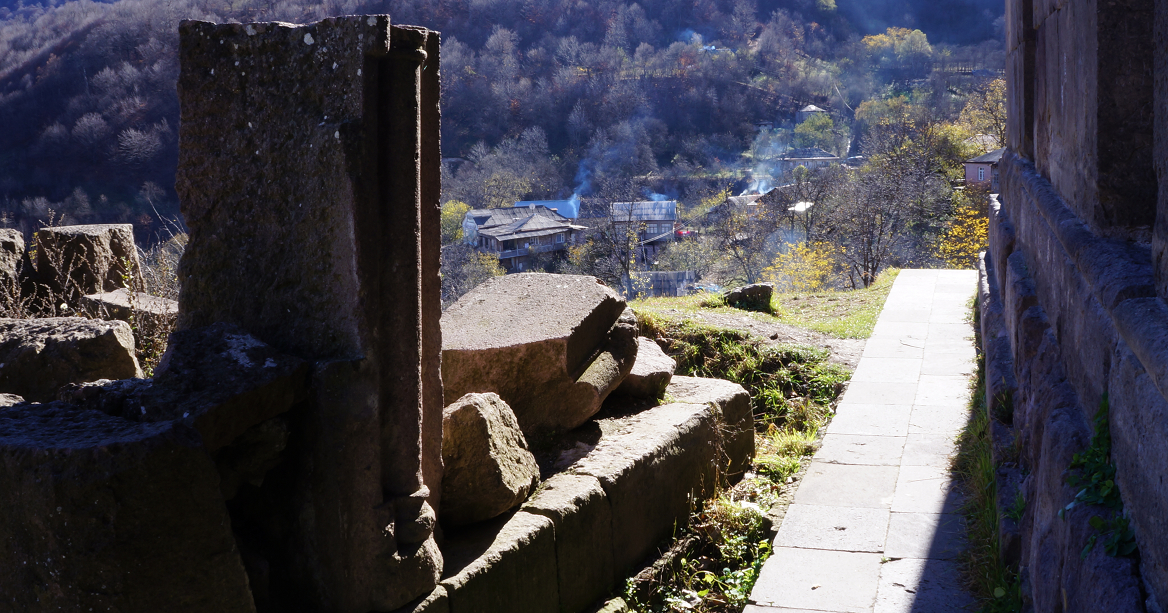
The convent sits under the top edge of the mountain, stone walls in front, basalt cliffs behind.

Kobayr- Ruins in side of mountain

On one side are dripping caves set into the cliffs.  It is absolutely quiet, and I guess has been for 900 years.  Here one of the places they worshipped.  Cold, stony, but with the soft light coming through the window, an easy place to pray:
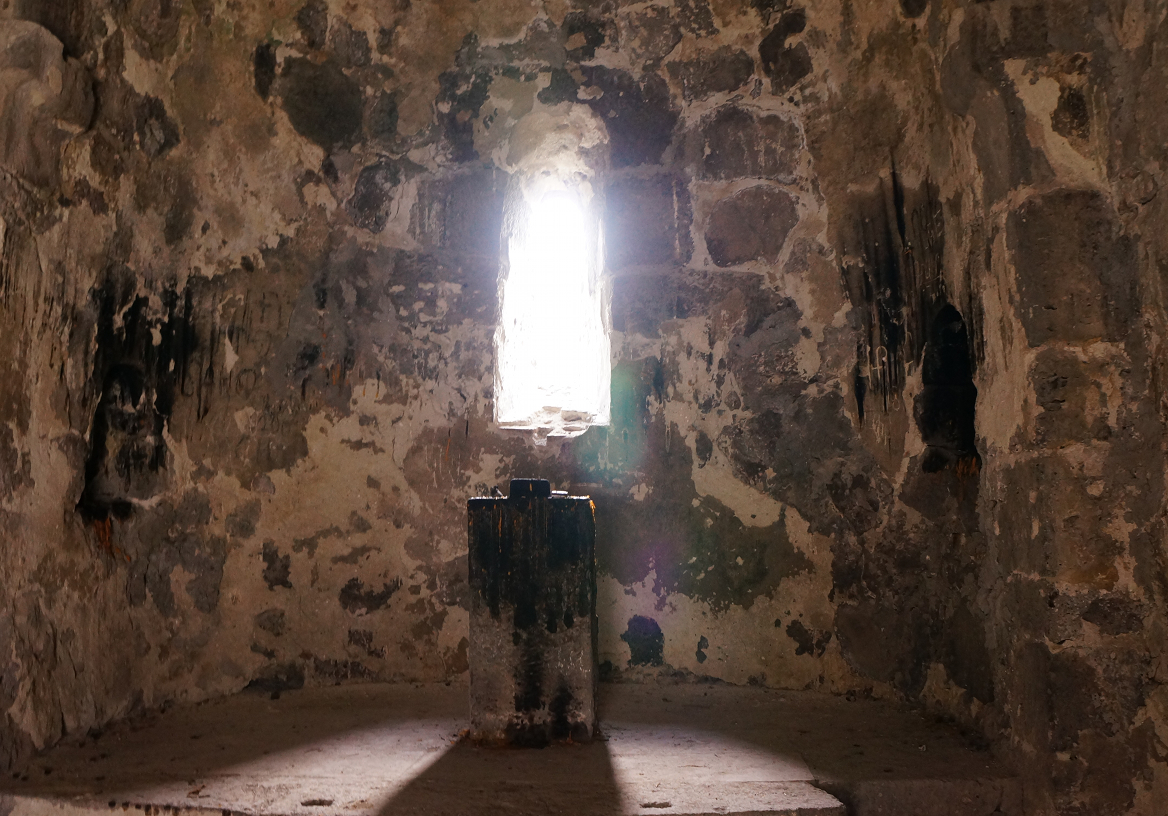
Kobayr- Here They Worshipped - sunlight inside chapel

There are 10-20m drops everywhere.  I feel the need to tie myself to something.  There were no safety rails in the 13th either,  every step just nearer to God.

The whole place is built from rocks, big rocks.  Cutting them, carrying them and carving them into shape is real musclebound work.  Fallen boulders everywhere, like marbles.  These must have been real muscly nuns.

Kobayr- Ruins of 13th Century Convent

I imagine them fending off drunk barbarians with a headlock.

On the road back I am threatened by a 3-legged dog.  Yes, one 3-legged dog.  Has he no friends?  Has my life come to this that even 3-legged dogs think they can take me on?

The clown has only 1 front leg.  So my battle plan, should one become necessary, is to knock the other one out from under him with my stick, and laugh.

(events 1 Dec 2012)

3 Comments

Walking along the top of the plateau (previous post) I pass donkeys loaded with firewood.  Short men with sticks keep them moving, as though the last two thousand years didn’t happen.

I am still about 4km from Dsegh.  Apple trees with tiny gnarled apples line the road.  The cool clear air, the height, the trees remind me of the road to the Hunza Valley in the Hindu Kush.  Fields of horses on the right.

Fruit Trees on Road to Dsegh

Dsegh turns out to be a very pleasant high plateau farming community.  Women in coarse dresses and head scarves carry buckets of stuff along the lanes, and stop to chat:

Dsegh Village Lane: Women working

Even in winter this place is fruit trees, stone houses, horses, cows, goats, chickens, and chubby pink pigs:

Dsegh: pink pigs in yard

I walk through Dsegh to the edge of a steep canyon and then down the side to the ruins of the 8th Century Surp Grigor Barzdzrakash Monastery.  The stones now covered in moss, the whole area a thick carpet of leaves.  It still seems a holy place:

Surp Grigor Ruins: Still a Holy Place

Red leaves, white light, stone Khachkars from the dark ages, asking for the salvation of the dead:

Khachkar at Surp Grigor Monastery ruins

On the walk back to Dsegh I help a woman carrying sacks of stuff to town.  Even the half I took was heavy.  No wonder Armenian women have a reputation as the working member of the family.  Unlike neighbouring Turkey there is no Bride Price [1] in Armenia, but for a women like this there ought to be.

Walked 17km today.  Lunched on bread and ‘tan’ (a whey drink).

I took a ride down the mountain to preserve my toes.  The driver couldn’t drive and feared not death.  A bad combination, especially in a rust-ridden Lada.  Most Armenians are devout, and drive like they are ready to meet their maker at any time.  I am not ready, and I doubt my maker is all that keen to see me again either.

Which is why I usually walk.

(events 30 Nov 2012)


Bride Price: Husband Getting His Money's Worth[1]  Bride price is paid to the parents of the bride.

In some societies it means that after marriage the man is going to sit around and do nothing, letting his wife do all the work.
Bride Price (like the custom of men sitting around doing nothing) has been around a while.  The Code of Hammurabi (1772 BC) regulated it and included provisions under which the man was entitled to a refund.

(That last picture of the husband getting his money’s worth isn’t mine, it was passed around the web many years ago, but if anyone knows who to attribute this to, let me know.  I would like to shake his hand.)

.
.


2 Comments

I am in the bottom of a deep, narrow valley and today the plan is to walk 11km to the top of the surrounding mountains to a town called Dsegh.  Then after lunch another 4km down the mountainside to some 8th century ruins.

I mention the route at breakfast.

“Wolves” they said.

“No problem,” I said, “I have a Big Stick and a Knife.

“And jackals,” they said, “in packs, 6 or 7, now very hungry”.

Jackals??  Wasn’t this (sort of) Europe?  I hadn’t read anything about jackals.  But then nobody had written about the wolves either.

OK, so what do I need for packs of jackals?  A chainsaw!  I imagine being surrounded by slavering jackals, firing up my chainsaw and growling, “Come on punks, make my day”.  But the nearest chainsaw shop was at least one, maybe two countries away.

So, only lightly armed – no chainsaw – I set out.  It is -8°C, clear and sunny as I cross the bridge into the badlands.  As if to emphasize that you are now on your own, some of the railings on the bridge are missing.

Farmhouse from the bridge to Dsegh

Through the gap a farmhouse, the last for a while.

I walk a few hours.  Sunny, fresh, nothing trying to eat me, though I don’t see anybody else walking.

Walking to Dsegh: Entering the badlands

As I climb, snow on the surrounding mountains; it is quite beautiful here:

Walking to Dsegh: Climbing the Badlands

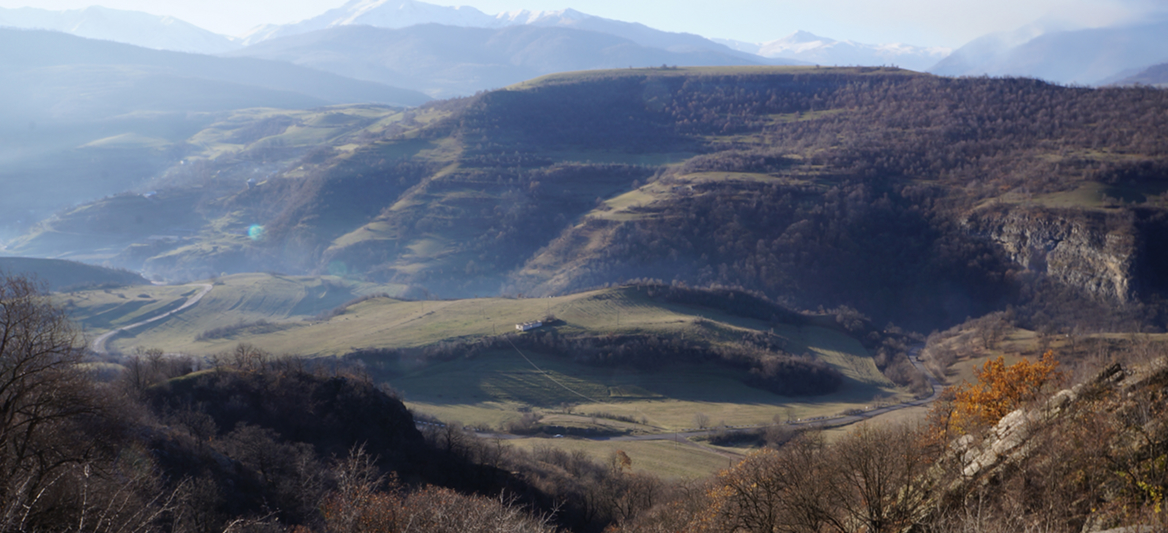
I reach the top: not as I was expecting, a mountain ridge but a high plateau covered in pastures.  The valley I’ve come from is just a narrow gash cut into the immense plateau.  From a distance it almost feels like you could jump across.

On Dsegh Plateau above Debed River Canyon

A lovely road and a beautiful climb.  I start to wonder why I listen to these people.  Maybe I will cancel that mail-order chainsaw.

(events 30 Nov 2012)

.


8 Comments

Vanadzor:  I wake up to -8°C, icicles on the roof and no electricity, water or heating.  Exactly how my father said I would end up.

26km to cover today but I take a taxi for the first 4km past the rusting semi-abandoned factories,  so my actual walk to Dzoraget will be 22km.  The driver, a friendly yet alert man who has seen a couple of wars, waits till I have shouldered my backpack and wishes me luck.

Past Pambak, stick hard-tapping the ground to warn dogs I am armed and unfriendly, I enter the (famous) Debed River Canyon.  Now -3°C, cold wind, some sun.  So far so good.

I start descending a valley.  I can hear the river way below.  Really a winter landscape, not much joy.  Just a few birds sing brief winter music.

The road winds down steeply to the river.  Bad for injured toes.  After the failure of the bubble wrap I am now wrapping my toes in a layer of cut kitchen sponge, held in place with duct tape (inside socks inside boots).  After a few hours I reach the valley floor and the river:

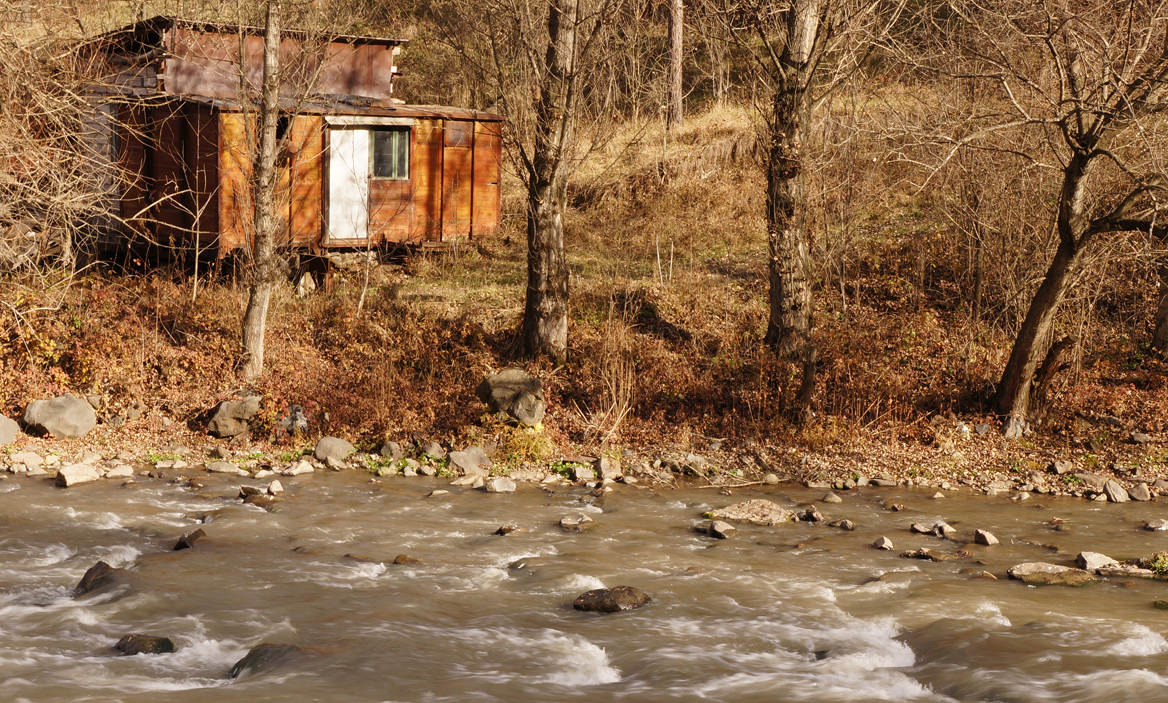
Debed Canyon floor, river and Orange House

At Vahagnadzor, I eat figs, apricots and almonds on a tree stump beside a stream.  My jacket is off so the  sweat I have accumulated evaporates.  I compliment a proud farmer on his pink pigs.  A nearby donkey joins me in lunch:

Debed Canyon, donkey  lunching

A few more hours and I should be near the turnoff to Antaramut but can’t see it.  Disheartened.

I curse all maps.  In the past maps showing towns which failed to materialize have caused me to get stuck in a sandstorm, almost run out of water in a desert, and spend a night in a place where my host guaranteed sincerely: we won’t kill you [1 ].  After several near death experiences, I have concluded that some maps are just made up.

But today, no big problem as the road runs right beside the river,  so eventually I will get somewhere.   And the river invites:  I could easily drop in for a swim:

Debed Canyon, road beside river

Hours later:  Quite a few tunnels here.  Deep, deep dark, and no footpath, just a thick accumulation of dust and rocks on the edge of the road.  Very unpleasant.

Then buildings, even though on the other side of the river:

Debed Canyon, Railway buildings near river

Then Dzoraget.  Finally I know where I really am, not just my latitude & longitude.

Debed Canyon, stone houses near hydro

And welcoming the weary traveler:  chickens and a laundry:

Debed Canyon, Dinner and Clean Clothes

I arrive at the Avan Dzoraget, a remarkable hotel between 2 canyon walls of black basalt, about 200m+ high and 80m wall to wall [2 ].   My room is over the river and has a bath!   The first in 2 months.  So I bathe twice.

Dinner:  lamb soup, then lamb stew, then Armenian coffee.  A tough place to be vegetarian.

Night, with a full moon over the mountain coming straight in the window, and the roar of the fast flowing Debed River below, I sleep well.

(events 29 Nov 2012)


[1]  It was evening in a remote place in south-east Pakistan.  Riding my motorbike (BMW R90S) south, I happened on a community who offered me a bed for the night.  The (I guess) headman said I should stay with them rather than another nearby community, because, quoting his reassuring words in full, “They will kill you, we won’t”.

[2]  A few days later I was to walk up to the plateau at the top of the valley.  In places it seemed a mere 50m across.  With good shoes, a long enough run-up, and an up-to-date last Will and Testament, it seemed one could almost jump across.


1 Comment

The Bed&Breakfast in Vanadzor was my first since age seven.

Hunks of lamb, seven kinds of pickles, bread and vodka were dinner, eaten in the kitchen.  I had mentioned I was vegetarian, They ignored it.  At dinner, when the home-made vodka was brought out, I added that I didn’t drink.  They laughed at an idea so foolish.

So as the home-made vodka ignited the chunks of lamb going down my throat, I thought, perhaps optimistically, this place may make a man of me yet.

The only other guest was a Kazakh agricultural economist, a taciturn Mongolian-gened woman given to vague answers and white bread with sausage.  The husband of the owner, an older Armenian spoke fondly of the Soviet days: free health care, free education, everything organized.  The Kazakh didn’t care:  “but now we have freedom”.

Not that this freedom is improving health.  A quick walkaround of Vanadzor grocery shops (like most in Armenia) turned up only 1 in 15 having milk, but every last one of them having at least 20 types of vodka.  No wonder by day the men appear poorly shaven.

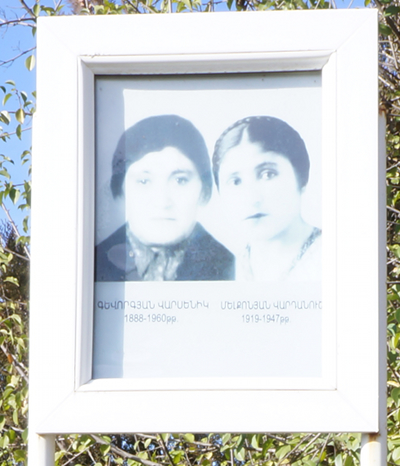
Mother and Daughter Buried Together, Armenian cemetaryVanadzor itself, despite a backdrop of snow-covered mountains, is a rusting city of semi-abandoned soviet era factories, so the less shown of it the better.

Instead this headstone, high on the mountainside cemetery, reminded me that even in crumbling places, people have lives, and sometimes these lives have great sadness.  Here a mother whose daughter died before her, in the hard times after World War II, still young at 28.  The two now lie together.

And perhaps as well, this women walking her (one) sheep by the railway tracks:

Woman Walking Her Sheep - Vanadzor, Armenia

(events 27,28 Nov 2012)


3 Comments

Set out today from Dilijan, -1°C, cool but clear and sunny.  The walk today is to Vanadzor, 32km and (according to Google maps) a climb of 3250m, so chicken porridge for breakfast to start the day right.  Yes it really is chicken in oats porridge, and doesn’t taste too bad.  A nice day to be on foot.

The road not far from Dilijan.  If you enlarge you may be able to see the 2 men on horses (on the track running past the small white building on the RHS):

Armenia, snow-covered mountain, road to Vanadzor

A few of my toes are wrapped in small-bubble bubble-wrap, stuck to my feet with duct tape (always carry duct tape!).  No time for limping today.  (In the evening when I took my socks off the bubbles had all burst – so no new product ideas here – but my toes were no worse, so perhaps the idea wasn’t among my 10 stupidest).

The road it turned out was uphill for about 28 of the 32km.  This picture was taken looking backward:

Armenia-Sun on snow-mountain, looking_backward

This is village country – small-scale farming, ploughed fields and grazing livestock.  Along the way were women selling huge cabbages and sacks of potatoes and carrots, good thick soil still clinging to them.  Cows and horses lunching beside the road.

Armenia-horse beside road

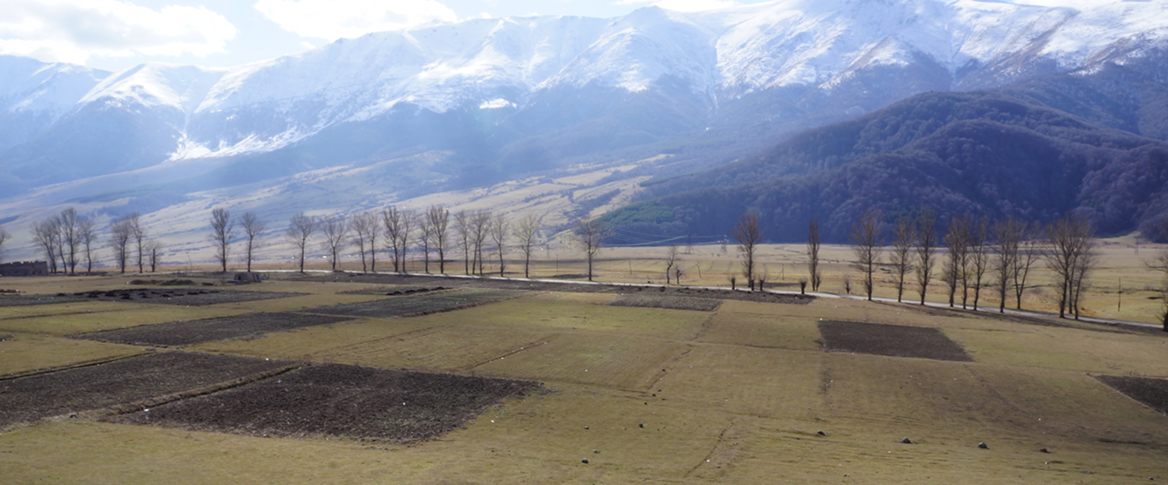
The fields were the green/brown of winter, and were surrounded by snow-covered mountains.

Armenia-Fields surrounded by snow-covered mountains

Too late I discovered that while there were villages on the way, none of them were selling anything to eat, or anything at all, and even the raw cabbages were well behind me now.

Armenia- village houses

By Margahovit there was an icy wind off the mountain.  Gloves on, hat on, hungry, cold.

Armenia-snow-covered mountains, cold plain

By Lermontovo I was more than 1/2 way and the road had been all uphill so far.  Nothing to eat here either, unless I run down a cow and cook it myself.  Unfortunately running down animals and eating them is a life-skill my parents failed to teach me.

Armenia, snow-covered mountain, dead bus in field

By Shaumyan the sun was starting to go behind the mountains and the sweet smoke of wood fires was rising from stone houses.

Finally, a shop on the outskirts of Vanadzor selling “tan”, a whey drink.  While not something we normally drink in financial capitals,  “Throughout history, whey was a popular drink in inns and coffee houses. When Joseph Priestley was at college at Daventry Academy 1752–1755, he records that, during the morning of Wednesday 22 May 1754, he “went with a large company to drink whey.” (Wikipedia).  It is the “liquid remaining after milk has been curdled and strained…”

Anyway, I drank 2 bottles of it, and as Mr Priestly might have put it, ‘felte greately refreshed’.

Arrived at my evening’s B&B as the sun was setting.

(events 27 Nov 2012)


4 Comments

Walked up a mountain today to Goshavank Monastery.  Sunny day, 3°C, the only sounds were birds and a stream, and the road sign ahead indicated a 12% slope.  It was cold in the shadows.

Mountain road to Goshavank Monastery, Armenia

Yesterday’s blue toes were now black, so the problem toes were taped and bandaged inside my boots.  I have no problem losing a few toenails, but worry losing toes would affect my marriage chances, especially in cultures where one has to remove ones shoes when entering a house.

Goshavank, founded in 1188, once had a library that held 15,000 books, a lot in the 12th century when they were all hand-copied.  They were burned by Timur, a fathead responsible apparently for the deaths of 17m people, about 5% of the world’s population at the time.  The history of Armenia is miserably punctuated by fatheads from just about everywhere coming through sacking monasteries, burning books and butchering locals.

Subsequently restored, Goshavank still has a quiet dignity.

Goshavank Monastery, Armenia

Given my chequered history, who’d have thought I would one day spend so much time visiting monasteries.  If only my parents, who lamented that I was godless, could see me now.

The monastery was in, and dominated the village of Gosh:

Goshavank Monastery, Armenia in town of Gosh

I stopped at a nearby store to buy some bread.  I rested my stick and stood outside to eat it.  An old woman motioned me to sit at a table on the balcony, and brought me salty cheese to eat with it, refusing to take money for it.    She sat with me, and told me in Russian that she milked the cow and pressed the cheese herself .  I don’t speak Russian, but the signing for milking a cow is universal.  I did however look up my Russian dictionary to confirm that she was talking cows not goats or horses or anything else.

I got up to leave but then her daughter, the shopkeeper, brought out fruit, cut it and we all ate.  I took their pictures but couldn’t capture the niceness of the old lady (on the left).

Eating hand-made cheese with Armenian old lady at Goshavank

She had a kind of harsh, unsmiling but genuine niceness and hospitality that took me a while to understand.  Once I understood it,  I was disappointed in myself for days that I had so missed capturing it.  The best I could do was to put her in the context of her daughter (the woman on her left with long hair), her friends, and the cheese.

(events 15 Nov 2012)


2 Comments